Showing posts with label provence. Show all posts

Thursday, 17 September 2009

Carlo Scarpalike

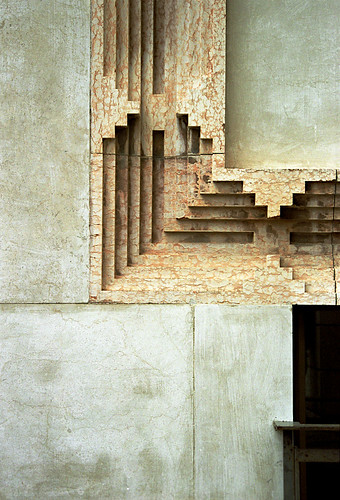
Some pictures of a couple of buildings by an architect in Provence, which we saw in Aix and Avignon, and who clearly wanted a bit of "Scarpa" in his works.

School in Avignon, unknown architect

The school above, which is in the old centre of Avignon, is difficult to find anything but painful,
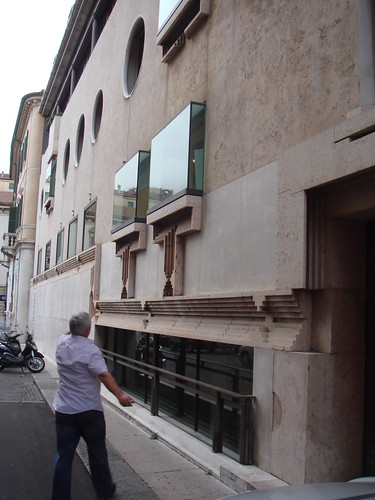
however the apartment building below in Aix, is quite an odd pleasure.
Apartment building in Aix-en-Provence, unknown architect
Walking around, and getting quite lost in the winding alleys of Aix, it was fun to have this building, bedecked with its little scarpa-esque ornaments, like cheap, but colourful costume jewelry thrown onto the most average of bodices, popping up every half an hour or so. It grounded that part of the town for us with the intimation of a sweet story about a young, provincial architect, visiting italy on a study holiday, and having been deeply moved by the Banca Popolare building, the Querini Stampalia, and the Olivetti Showroom, and considering it his personal mission to bring a little something of that magic back to provence.


There was another building around the corner, much more recent, more restrained, and with a rather enlarged budget. It was in effect a handsomely proportioned French Town House, built in stone, but with hugely over articulated window frames, that geometrically followed through into the cornice lines, rendered in the typical stairlike, staggered, Scarpa profile. It was however definitevely less endearing for being so well finished, and so elegantly proportioned.

Friday, 11 September 2009

Seriality, Suspense and Holiness at the Abbeys of Senanque and Silvacane

These two abbeys are the companions in style, order, and period of the previously posted Thoronet Abbey. I said in the post on Thoronet that at some point in the future I would like to go back there "in order to get a better understanding of its appeal", a commitment that held absolutely no pleasure for me, and felt more like a necessary obligation stemming from the lack of emotion stirred in me by that great monument of southern france, lauded by so many architects, and whose lack of instinctive appeal to my sensibility left me feeling rather left out. I could appreciate the intimacy between the organisation of the abbey, and the highly structured routine of the cistercian monks, and how its layout, its design, and even the stonemasonry were to some extent ways in which the order's philosophy was brought into life and material; but the walls were all so bare, the proportions of the stone blocks in relation to the bays and the vaults seemed neither disordered enough, nor composed enough to be either charming or inspired, the light was too abundant to be mysterious, and was somehow flattened into infinite degrees by the dearth of any event, decoration, modulation or flourish on any of its inner surfaces. At best the place left me slightly lost as to my lack of 'wonder', and at worst irritated me as much as if I had been given a plate of diced carrots at a well known restaurant, and been told to "close my eyes and appreciate them one by one". However there were two moments to which I was drawn, the staircase that had been jammed into the corner of a "perfectly" barrel-vaulted hall, and the strange little hexagonal pyramid which sat in the garden of the cloisters, and which was grafted on to their southern end, containing the be-tentacled fountain that served as the monk's washroom (you can see this in the youtube video). In another abbey, I may not have clung quite so much two these two moments, which are lovely, but not remarkable in themselves; but in amongst the interminable grey volumes of evenly divided stone that uniformly unify Thoronet, they shined like gems by virtue of contrast. It seemed that the more acreage of orderly simplicity was bestowed on my eyes by the abbey, the more precious any rupture in that smoothness would seem; and since there was so much uniformity and smoothness, and very few exceptions, like the principle that increases the fetishistic power of a body part in relation to how little else is shown, all architectural pleasure was condensed into those two moments of rupture, heightening their potential to give pleasure far out of proportion with any objective interest they may have embodied.
That specific enjoyment, which for me was the main delight of the abbey (and formed in my memory a sort of 3dimensional, spatialised version of the filmic technique of accumulated suspense), was one I only managed to pinpoint after having visited Senanque and Silvacane abbeys which I enjoyed in much the same way.


Silvacane Abbey

Senanque Abbey

Senanque AbbeyTheir seriality was remarkable, with the organisation of the three being almost identical; and just as small exceptions were emphasised by the marching rigour prevalent around them within each abbey, so the slight differences between the three abbeys were made terribly exciting by their otherwise total correspondence. The site and context of each of them was the most obvious difference, and changed the way they were approached, but even within the abbeys we found ourselves pouring over the plans on the tourist leaflets, trying to figure out what was different, however tiny. The most notable change of all was at Senanque abbey, where the chapel had been oriented differently (see below), meaning that on the approach, rather than the usual picturesque cluster, one saw a facade that differed completely from the other two, dark and monolithic as a medieval fortification, and punched full of variously sized windows.

Senanque Abbey
More After The Break...

Wednesday, 2 September 2009

Monochrome Gordes and its Voluptuous Church

Scenographicaly perched atop the crest of a hill, Gordes is your perfect little Provencal stop, packed full of shops selling cute handmade nick-nacks, and plump with Estate Agents advertising villas in the region. Respectfuly impressed and well behaved tourists mill around its streets, and sit on its steps making use of the free wi-fi network.


The buildings and streets are all made of the same, yellowish stone, and for the first fifteen minutes it is easy to admire the way in which the strong light in this part of the world carves-up the architectural forms, breaking them into sharp and abstract shapes. But after fifteen minutes the light grows too strong, and whatever visual pleasure there is to be gained from contemplating fortuitously assembled, sunbathing stone houses, is somewhat undermined and emtptied by their containment of a branch of 'Knight Frank', or of 'Christie's Property'. The juxtaposition carries with it a comparison of the village's sobre and monochrome aesthetic, with the aesthetic of tasteful, or rather neutral, decorum so uniformly held up as correct by those who sell property for a living in the United Kingdom. The pretty village of Gordes becomes an embodiment of the kind of restrained moderation that helps differentiate those who have taste from those who dont, the kind of uber snobbery in which one is more showy, and more snobby, precisely by showing less -but showing less in just the right way. The shadow-carved forms start to feel as oppressive as do all the endless and unstoppable waves of pristinely finished white-on-white english apartment interiors. Almost exactly the same streets in other villages, that looked almost exactly the same, did not have the same effect, but in Gordes it was overwhelming. Overwhelming at least until I stepped into the main church, from which I expected nothing but another dark, romanesque interior sliced out of perfectly cut stone.


The facade was as yellow, and uniform, as any other of the buildings, but stepping inside was a vertiginous thrill. The oppressive feeling of the situation outside, where I had felt the drab weight of convention pressing in on me from each alley-way, was positively turned inside out and set off like so many fire-works. It was as if the church committee had given the job of decorating the place to an over-enthusiastic member of the congregation, who had proceeded to go wild in her inspiration, drawing material from a combination of architectural pattern books, and the array of patterned plastic table-cloths she happened to have at home. It was an adorable, fun, and ultimately rich interior which, to my pleasure (and totally contradicting the sentiment I had had outside about the people visiting the village) was very much enjoyed by the several English admirers whose conversations I happened to eavesdrop into whilst inside.


niches sport the remains of liberaly applied volcano-red, and themselves cut into huge expanses of orthogonaly arranged cobalt-blue clover-leafs on an aqua-marine ground, all moulding away ever so gracefuly.

And plasterwork ornament, alot of it oddly formed somewhere between baroque and rococo, but always slightly strange, and all painted and powdered like a little girl who has been overly zealous in the application of her mother's make-up. Foundation, concealer, and blusher, to soften and shape the curves, and highlighter and mascara to pull it all together, sharpen the edges and bring out the colours, all liberally, and exuberantly applied.


Friday, 14 August 2009

La Thoronet Abbey (L'abbaye du Thoronet)

A short film, made of photos taken with my Canon 30D, showing some of the moments that struck me during an unfortunately short visit to this wonderful Abbey (one of the three Cistercian sister abbeys from the 12th and early thirteenth centuries in Provence). The spaces that can be seen in order are the southern aisle and the approach to the aisle's corresponding apsidal chapel, a small room situated a half level above the dormitory, the terrace area above the cloisters, the lean-to barrell vault of the northern aisle in the chapel, the nave, the Chapter-House, a nave-pier, the fountain positioned in the cloister courtyard, and whose roof can be seen as an hexagonal pyramid in the footage from the terrace, and final two exterior views, one from the south, and another of the exterior of the apse. The place had a strong influence on Le Corbusier, culminating in the realisation of the sublime La Tourette monestary designed by him for the Domincan Order. I will be going back at some point in the not too distant future to spend a day there, and hopefully an evening, in order to get a better understanding of its appeal.


The embedded video above is cut in half, to see it full size, go to the youtube page here

This is a photo of the corner of the dormitory -a long rectangular hall with a barrel-vaulted ceiling- in which a staircase was added at some point to access both the attic above, and an intermediate level in the adjacent structure, creating a rather dynamic, turning compression of penetrated solids pressed between the vault, floor and walls...


Plan: