Thursday, 29 October 2009

Architectural Conversations, Allusions and Polychromy in Place De La Concorde


Place de la Concorde, the largest square in Paris is framed on all its sides by national landmarks: on one the Hotel Crillon, a luxury hotel once favoured by Marie Antoinette, swimming in white and honey coloured marbles and gilding, was, the few times I walked past it, appropriately adorned by its automotive equivalent, a walrus-like white and gold Rolls Royce; the other sides respectively accomodating the National Assembly (previously the Palais Bourbon), the beginning of the Champs Elysees, and the Tuileries Gardens.


The decorative scheme of this vast Place, designed by the architect Jacques Ignace Hittorf, and including two large fountains and a marching border of Rostral Columns, resembles more the carefuly considered and decorous elegance of a Parisian dining table than a European Square. Balancing exotic motifs and a rich, uniform colouring of sea-green highlighted with gilding, the fountains and columns manage to maintain all the allusions to ancient Rome of the high Empire style, but without any of its drum-beating pomp and bellicose, self satisfied profusion of clashing forms and colours.


Place de la Concorde has all the grandeur of a witty feminine display that at once seduces and beguiles you with its harmoniously resolved conceits, delivered with an easy and languorous tone, while slipping through an underlying message of strength and resolute confidence. There is a conversation going on between the Crillon, Assembly, Tuileries and Champs Elysees, and it is happening over the Place, whose arrangement of emerald items adorn, frame and conduct their discussion as a dinner service both generates an atmosphere and helps choreograph the sequential unfolding of an evening's events.


Hittorf was a great proponent of Polychromy in Architecture, fighting his ground against the "purists" in the Beaux-Arts after discovering that ancient Greek Temples had been heavily coloured. This led to the deep green ground of the Concorde, and the intended richness of colour in St Vincent de Paul, which, unfortunately, was not completed to his saturated designs.
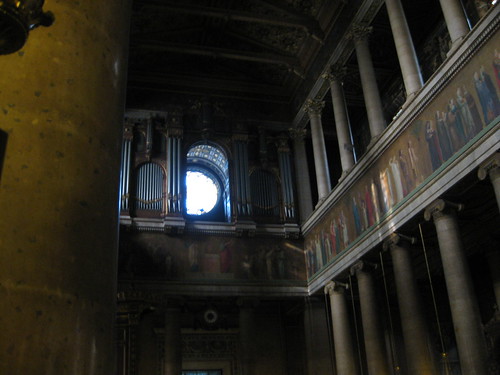
St Vincent de Paul

Although, partly inspired by Hittorf's discoveries and all the dazzling and mysterious aesthetic splendour of the ancient world they implied, just around the corner you can visit the Atelier of Gustave Moreau, where there is more than enough painterly recreations of strange, bejewelled, encrusted and coloured worlds both to make you want to re-read Flaubert's Salammbo and Herodias, and to make up for Hittorf's unfinished masterpiece.

Detail of Salome by Gustave Moreau

Even today most discussions in architecture about colour have to be formed as apologias, as if such an indulgence were something that must be defended. In the nineteenth century, after Hittorf's discoveries, at least architects had the ever-expansive precedent of the classical world to cite as justification, with evidence ever increasingly proving the predominance of pigment in the ancient meditteranean, confounded by the ongoing excavations in Pompeii and the unearthing of its interiors that were as red as pottery and as warm as flesh. Joseph Rykwert, in his article the Polychromy of Greek Temples in edition 2 of Terazzo, even goes so far as to say that the Greeks never even considered leaving white surfaces bare (naked in their eyes), only leaving yellowish stones like Tufa or Poros without treatment, and if marble, covering it with stucco -the colour of sunlight, or at the very least staining it in a Saffron emulsion. Today however there are no such precedents to cite, and the seductive allure of pigmentation seems forever either stuck in the supporting, diagrammatic role of spatial and structural differentiation, or else as a guilty, irrational pleasure, that because of its powerful and direct appeal to the senses, can be used, but in a tightly controlled and restrained fashion, lest it swamp the practical and cerebral core of Building.

capital from stadium entrance in Olympia, by Ernst Curtius and Friedrich Adler 1896

Speaking of ancient allusion and precedent, the columnar lamposts in the Concorde, although refined and delicate, refer to an ancient tradition both imperial and antagonistic. Under all the civility of Hittorf's design, there is both the earthiness inherent in the depths of his greens, and the base swagger of the unapologeticaly triumphant: the lamposts are a rare (at the time) reinstatement of an ancient Roman tradition/motif, the nautical equivalent of their Triumphal Arches through which a returning army would pass in celebration of a conquest with its spoils, both human and financial.


Ancient ships used to have huge brass rams at their fronts, which were their main form of attack. They would speed as fast as possible into their enemy, ploughing into its side and hoping to break the other vessel in two. Following an important naval victory against the Etruscans (the first recorded) in 338BC, at Anzio, the Romans severed the Rams from the surviving Etruscan ships and attached them to walls in the Comitium, a gathering place in the Forum, to declare the vanquishing of the enemy fleet.

Reconstruction of the Rams in the Comitio

In 260BC, following a defeat of the Carthaginian fleet, the Romans erected a column in the Comitio onto which the captured Rams (also known as Rostra) were attached, creating a stand-alone monument, and a new form of column, embodying naval might and prowess, now known as a Rostral Column.

The position of a Rostrum on an ancient ship, and on a Rostral Column

After the battle of Actium, in which the Romans devastated Antony and Cleopatra's fleet, the Rostral Column was moved to a large Altar which developed into a platform from where speakers would address crowds at the Forum (hence the word Rostrum now also meaning a place from where public speakers address a crowd), sealing its position at the heart first of the Republic, and later of the Empire, meaning its form and symbolic meaning have survived to this day via classical interventions in our cities created by architects like Hittorf, and commemorating events as varied as the Battle of Lepanto, and the desire of Louis-Phillipe to imply some kind of imperial glory during his relatively morbund reign (during which the square in its current form was commsioned).


And to conclude on an entirely whimsical note that returns to the dining table, I finaly managed to purchase in Paris this figure of Paris offering his golden Apple to Aphrodite, an act inspired by voluptuosness and passion, but pregnant with the saga of an epic war and which here, in this little piece of porcelain, was compressed by the taste of the eighteenth century into a charming ornament for the desert service, whose purpose was to please the eye, and to direct conversation in case there happened to be a dearth of topics.

Saturday, 3 October 2009

Geneva's Time and Timelessness


Departures Hall


The old terminal of the city’s airport is an essay in well proportioned, precisely detailed, slick high modernism, of the sort that in any other country would either be so hidden by a grimy cake of ill considered additions, and a total lack of cosmetic maintenance, that its original virtues would be entirely submerged; or else would have been lovingly rediscovered, restored, and elevated to a higher plane of architectural existence by the status of historical idol-hood that is conferred on a building together with the ‘heritage’ budget for its restoration.


Facade of Main Terminal Building


Elsewhere the building would have been through several cycles, through which it would have suffered and been reborn, or at least seen itself be modified and altered repeatedly to accommodate evolving circumstances, the place would have been marked by time, but this building seems totally frozen at the moment of its inception, perfectly maintained on the cusp of the 1970s, unchanged except for a few television screens for displaying arrival times, that look as if they are from the 80s. It doesn’t have the totally contemporary bright-shiny-modernity of the renovated Royal Festival Hall (that impossibly idealised past newness, like aggressive plastic surgery), but is instead a slightly faded form in whose lack of lustre, but abundance of intact atmosphere, can be read a consideration and awareness of aging and decay that is far more consistent, perhaps frighteningly so (like embalming at birth) and far less sentimental than our fitful, and guilty, reconstructions of buildings raped by inconsideration. In this rigorously petrified architecture, which seems to deny time, there are endless parades of posters and advertisements for luxury watches, from the whole gamut of manufacturers in the area (you can see two in the right of the first photo) from Audemars Piguet to Baume et Mercier and Rolex.

Advertisment for a luxury watch in Geneva Airport


These adverts seem to cluster into three groups, those that draw lines of reassurance from the past into our present, and by implication into a comfortably recognisable future; those that assure timeless worth through the scarcity value of the materials from which they are constructed; and those that thrust with the confidence and bravura of jet-engines, or fast cars, into a positively exciting future. The designs follow suit, with the first type all looking like bizarrely overcomplicated Victorian scientific devices (usually with a hint to the nautical) that I would have thought only Hollywood, or Tim Burton, could conceive of; the second type forming themselves as miniature display cases designed to show off their burden of diamonds or even, as above, their weight of genuine moon dust; and the third uniformly composed of two ingredients -although at varying quantities, these being the angular implication of movement and speed taken from the silhouette of a stealth fighter, and the massive punch and carved strength taken from the jutting profile of a tank.

With all of these posters, and in the building itself, there is a distinct lack of the kind of novelty and newness which was so prevalent in the Heathrow that I had just left. Even the posters of futuristic looking watches looked terribly obvious, old somehow, completely without any forms that might surprise, even in the slightest way. They are all about circumventing time, whether by being sure of the future through your connection with the past, through the assurance of a ‘timeless’ quantitative value, or through the confidence of a masculine arrogance; and all perfectly framed within a building that seems to be a fulfilment of all their promises, a fossilized but living nexus, unchanged in all its main elements, cared for and maintained as if it were intrinsically valuable, and still looking to a bright future from back at the apogee of the modern traveller’s glamorous past.

Office building on the lake front

It was by parts thrilling and sad, I felt as if I were Donald Draper in MadMen visiting the city back in the day, bronze door handles, dapper suits and all, and the illusion only gets stronger if you are visiting as briefly as I did, and only have time for a momentary walk around the city, because its waterfront is clad in exquisitely maintained modern palaces from the same period, perfect boxes of Gordon Bunshaft slickness arrayed around the lake and the river as if they were counting down the days to their inception. Those buildings were thrilling, I could imagine the whole place like a little Florence of the 60s, but then accompanying these buildings wasn’t any art, decoration, invention or even glamour, just adverts and products like the kind below. Lots of little timelessnesses that can be melted down, and would either still hold their value, or be worth even more.

Thursday, 17 September 2009

Carlo Scarpalike

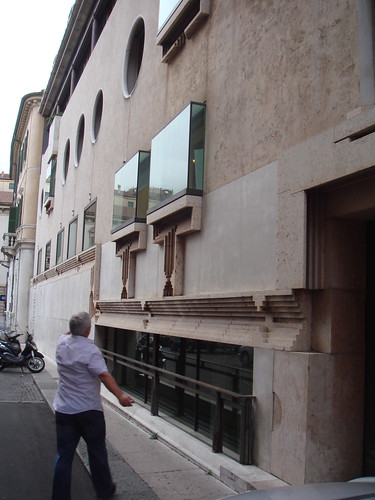
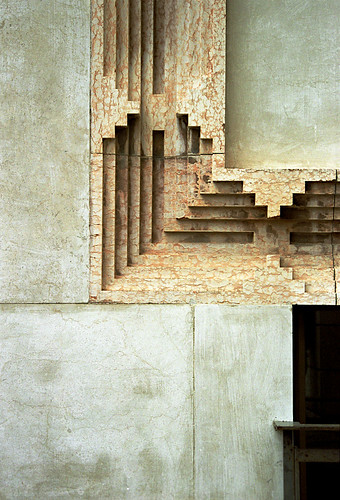
Some pictures of a couple of buildings by an architect in Provence, which we saw in Aix and Avignon, and who clearly wanted a bit of "Scarpa" in his works.

School in Avignon, unknown architect

The school above, which is in the old centre of Avignon, is difficult to find anything but painful,

however the apartment building below in Aix, is quite an odd pleasure.
Apartment building in Aix-en-Provence, unknown architect
Walking around, and getting quite lost in the winding alleys of Aix, it was fun to have this building, bedecked with its little scarpa-esque ornaments, like cheap, but colourful costume jewelry thrown onto the most average of bodices, popping up every half an hour or so. It grounded that part of the town for us with the intimation of a sweet story about a young, provincial architect, visiting italy on a study holiday, and having been deeply moved by the Banca Popolare building, the Querini Stampalia, and the Olivetti Showroom, and considering it his personal mission to bring a little something of that magic back to provence.


There was another building around the corner, much more recent, more restrained, and with a rather enlarged budget. It was in effect a handsomely proportioned French Town House, built in stone, but with hugely over articulated window frames, that geometrically followed through into the cornice lines, rendered in the typical stairlike, staggered, Scarpa profile. It was however definitevely less endearing for being so well finished, and so elegantly proportioned.

Friday, 11 September 2009

Seriality, Suspense and Holiness at the Abbeys of Senanque and Silvacane

These two abbeys are the companions in style, order, and period of the previously posted Thoronet Abbey. I said in the post on Thoronet that at some point in the future I would like to go back there "in order to get a better understanding of its appeal", a commitment that held absolutely no pleasure for me, and felt more like a necessary obligation stemming from the lack of emotion stirred in me by that great monument of southern france, lauded by so many architects, and whose lack of instinctive appeal to my sensibility left me feeling rather left out. I could appreciate the intimacy between the organisation of the abbey, and the highly structured routine of the cistercian monks, and how its layout, its design, and even the stonemasonry were to some extent ways in which the order's philosophy was brought into life and material; but the walls were all so bare, the proportions of the stone blocks in relation to the bays and the vaults seemed neither disordered enough, nor composed enough to be either charming or inspired, the light was too abundant to be mysterious, and was somehow flattened into infinite degrees by the dearth of any event, decoration, modulation or flourish on any of its inner surfaces. At best the place left me slightly lost as to my lack of 'wonder', and at worst irritated me as much as if I had been given a plate of diced carrots at a well known restaurant, and been told to "close my eyes and appreciate them one by one". However there were two moments to which I was drawn, the staircase that had been jammed into the corner of a "perfectly" barrel-vaulted hall, and the strange little hexagonal pyramid which sat in the garden of the cloisters, and which was grafted on to their southern end, containing the be-tentacled fountain that served as the monk's washroom (you can see this in the youtube video). In another abbey, I may not have clung quite so much two these two moments, which are lovely, but not remarkable in themselves; but in amongst the interminable grey volumes of evenly divided stone that uniformly unify Thoronet, they shined like gems by virtue of contrast. It seemed that the more acreage of orderly simplicity was bestowed on my eyes by the abbey, the more precious any rupture in that smoothness would seem; and since there was so much uniformity and smoothness, and very few exceptions, like the principle that increases the fetishistic power of a body part in relation to how little else is shown, all architectural pleasure was condensed into those two moments of rupture, heightening their potential to give pleasure far out of proportion with any objective interest they may have embodied.
That specific enjoyment, which for me was the main delight of the abbey (and formed in my memory a sort of 3dimensional, spatialised version of the filmic technique of accumulated suspense), was one I only managed to pinpoint after having visited Senanque and Silvacane abbeys which I enjoyed in much the same way.


Silvacane Abbey

Senanque Abbey

Senanque AbbeyTheir seriality was remarkable, with the organisation of the three being almost identical; and just as small exceptions were emphasised by the marching rigour prevalent around them within each abbey, so the slight differences between the three abbeys were made terribly exciting by their otherwise total correspondence. The site and context of each of them was the most obvious difference, and changed the way they were approached, but even within the abbeys we found ourselves pouring over the plans on the tourist leaflets, trying to figure out what was different, however tiny. The most notable change of all was at Senanque abbey, where the chapel had been oriented differently (see below), meaning that on the approach, rather than the usual picturesque cluster, one saw a facade that differed completely from the other two, dark and monolithic as a medieval fortification, and punched full of variously sized windows.

Senanque Abbey
More After The Break...

Friday, 4 September 2009

Latitude 43

Sitting above Saint Tropez like a quietly disapproving wall of imperiously white rectitude, Latitude 43 looks like some kind of hospital for patients who have been mortally overwhelmed by the excesses in the city below.

the video above is cut to half its width by blogger, please go here for the full version

The 30degree kink in its body, together with the stacking up of floors towards a pinnacle at the rear surmounted by an industrially positioned chimney of some kind, make the building look as if it is not only some kind of sanatorium, but a boat as well, stuck on land, but forever trying to sail away, packed full of its neurotic patients, towards some past mechanical future where it can finally berth itself.

However the people that I spoke to in Saint Tropez about it didnt seem to read its aloofness, separation and horizontality in the same way, they rather preferred to see the building as a part of their own contemporary mythology of fame. The inference was made that because the building is white, and from the 1930s, and this is Saint Tropez, it must be by the most famous architect of all time, Le Corbusier; and indeed, for many this building is simply another affirmation of the place's singularity, not silently trying to sail away into the Provencal landscape, but in fact proudly moored in the ground, loudly exclaiming its presence as brashly as the biggest super-yacht in the harbour.

Either way, as you approach it (after having crossed the no entry, private property signs), it reveals a more delicate side. The kink is sensitively used underneath as a threshold between the public road and the shared entrance gardens and pavilion, on the facade as a way to soften the repetitiveness of the layered horizontals, and on the roof as a way of mediating between the two main volumes of the building.


All major terminal edges are either beveled, rounded, or punched through with slightly comical round windows, adding a whimsical and light hearted flavour, in that they seem to be attempting to achieve something like the elegant distortion of the rectangular forms attained by the kink, but instead only embellish and busy them like children sitting in on a serious conversation, interjecting occasionally with delightful but irrelevant remarks.

The small house just next to the main building being like the extension of this tendency at a larger scale.


Wednesday, 2 September 2009

Monochrome Gordes and its Voluptuous Church

Scenographicaly perched atop the crest of a hill, Gordes is your perfect little Provencal stop, packed full of shops selling cute handmade nick-nacks, and plump with Estate Agents advertising villas in the region. Respectfuly impressed and well behaved tourists mill around its streets, and sit on its steps making use of the free wi-fi network.


The buildings and streets are all made of the same, yellowish stone, and for the first fifteen minutes it is easy to admire the way in which the strong light in this part of the world carves-up the architectural forms, breaking them into sharp and abstract shapes. But after fifteen minutes the light grows too strong, and whatever visual pleasure there is to be gained from contemplating fortuitously assembled, sunbathing stone houses, is somewhat undermined and emtptied by their containment of a branch of 'Knight Frank', or of 'Christie's Property'. The juxtaposition carries with it a comparison of the village's sobre and monochrome aesthetic, with the aesthetic of tasteful, or rather neutral, decorum so uniformly held up as correct by those who sell property for a living in the United Kingdom. The pretty village of Gordes becomes an embodiment of the kind of restrained moderation that helps differentiate those who have taste from those who dont, the kind of uber snobbery in which one is more showy, and more snobby, precisely by showing less -but showing less in just the right way. The shadow-carved forms start to feel as oppressive as do all the endless and unstoppable waves of pristinely finished white-on-white english apartment interiors. Almost exactly the same streets in other villages, that looked almost exactly the same, did not have the same effect, but in Gordes it was overwhelming. Overwhelming at least until I stepped into the main church, from which I expected nothing but another dark, romanesque interior sliced out of perfectly cut stone.


The facade was as yellow, and uniform, as any other of the buildings, but stepping inside was a vertiginous thrill. The oppressive feeling of the situation outside, where I had felt the drab weight of convention pressing in on me from each alley-way, was positively turned inside out and set off like so many fire-works. It was as if the church committee had given the job of decorating the place to an over-enthusiastic member of the congregation, who had proceeded to go wild in her inspiration, drawing material from a combination of architectural pattern books, and the array of patterned plastic table-cloths she happened to have at home. It was an adorable, fun, and ultimately rich interior which, to my pleasure (and totally contradicting the sentiment I had had outside about the people visiting the village) was very much enjoyed by the several English admirers whose conversations I happened to eavesdrop into whilst inside.


niches sport the remains of liberaly applied volcano-red, and themselves cut into huge expanses of orthogonaly arranged cobalt-blue clover-leafs on an aqua-marine ground, all moulding away ever so gracefuly.

And plasterwork ornament, alot of it oddly formed somewhere between baroque and rococo, but always slightly strange, and all painted and powdered like a little girl who has been overly zealous in the application of her mother's make-up. Foundation, concealer, and blusher, to soften and shape the curves, and highlighter and mascara to pull it all together, sharpen the edges and bring out the colours, all liberally, and exuberantly applied.